
AI Can Reinvent Software. It Cannot Invent the Data

Posted by Ian Gelling
September 14, 2026
The Digital Builder continues the conversation about AI in the Built Environment.
In his latest article Miguel Sanchez Miguel sets the boundaries of what AI can and cannot achieve.
Data is fundamental in the Built Environment
The article argues that while Artificial Intelligence is transforming how we interact with technology, it does not eliminate the fundamental importance of data. In fact, particularly within the Built Environment, AI makes the need for well-structured, interconnected and governed data more urgent.
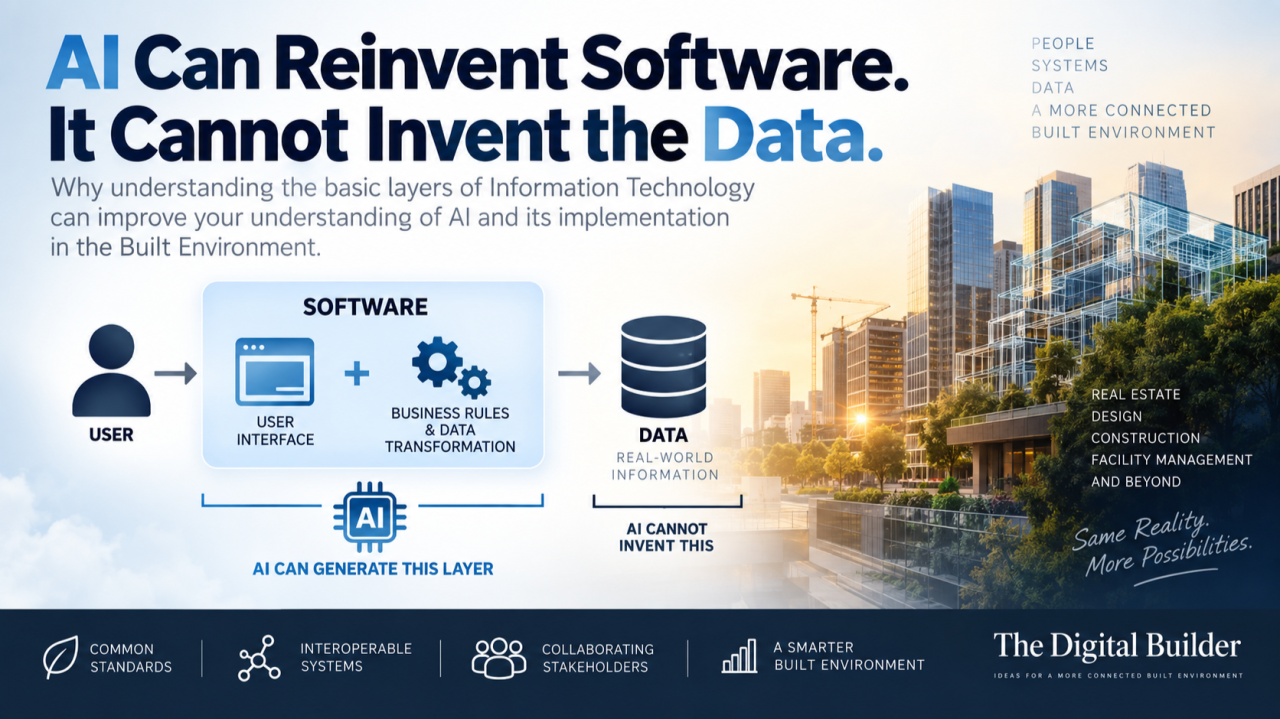
Traditional information systems can be simplified into User → Software → Data. Historically, significant effort has been invested in the software layer: developing interfaces, workflows, business rules, reports, dashboards and integrations that allow users to access and manipulate data. AI is beginning to transform this model by dynamically interpreting user requests and generating much of the software logic required to answer them. A user might ask AI to identify buildings where energy consumption has increased by more than 15% and determine possible causes, without a developer having previously created a dedicated report or application.
However, AI cannot create the underlying reality represented by the data. It cannot reliably answer questions about buildings, assets, meters, systems, contracts, responsibilities or costs if those things have not been properly identified, related and represented in the first place. AI can increasingly generate software, but it cannot invent reality.
Consequently, the article suggests that the strategic focus should increasingly move towards the DATA layer. Structured and normalized datasets, persistent identifiers, common classifications, semantic consistency, APIs, interoperability, permissions and governance remain essential. AI can help automate data transformation and integration, but it cannot remove the need for a reliable information foundation.
This challenge is particularly significant in the Built Environment, where information is fragmented across Real Estate, Architecture, Engineering, Construction, owners, Facility Management, maintenance providers, energy companies, manufacturers and public authorities. Different stakeholders often maintain separate representations of the same buildings, assets and activities, creating organisational and application silos.
Other examples
The article compares this situation with the travel industry, where initiatives such as Amadeus helped establish common digital infrastructure connecting airlines, agencies and other participants. The key achievement was not another application but an interoperable information ecosystem allowing independent organisations and systems to work together.
The author argues that AI will therefore make interoperability more important, not less. Poorly classified, duplicated, inconsistent or inaccessible information will limit AI’s effectiveness. Rather than simply asking, “How can we add AI to our software?”, the Built Environment should ask, “How should we organise the information ecosystem so that humans, applications and AI can all work with the same reality?”
The proposed direction is a Built Environment Data ecosystem based on common representations of Elements such as Assets, Systems, Places, Documents, Contracts, Organisations, People, Works, Tasks and Costs, together with their relationships. The guiding principles are that Elements must be interconnected, Systems must be interoperable, and Stakeholders must collaborate.
The article concludes by introducing the author’s practical work around the CAFM Table of Elements, BEM 8+3 Framework, BRUCE Platform, BruceBEM and Bruce AI. Together, these concepts aim to create an information environment in which people, systems, organisations and AI can work from the same interconnected representation of the Built Environment. The central message is that AI may reinvent software, but it does not eliminate the need to structure reality.
Feel free to visit the article, and comment. We really need to get this conversation going, and Miguel would appreciate your input.
Watch this space for more Digital Builder articles in the coming weeks.
Archibus Hosting Services has been providing IWMS solutions in The Cloud since 2007. Our experience is many and varied. Read more about us HERE.